

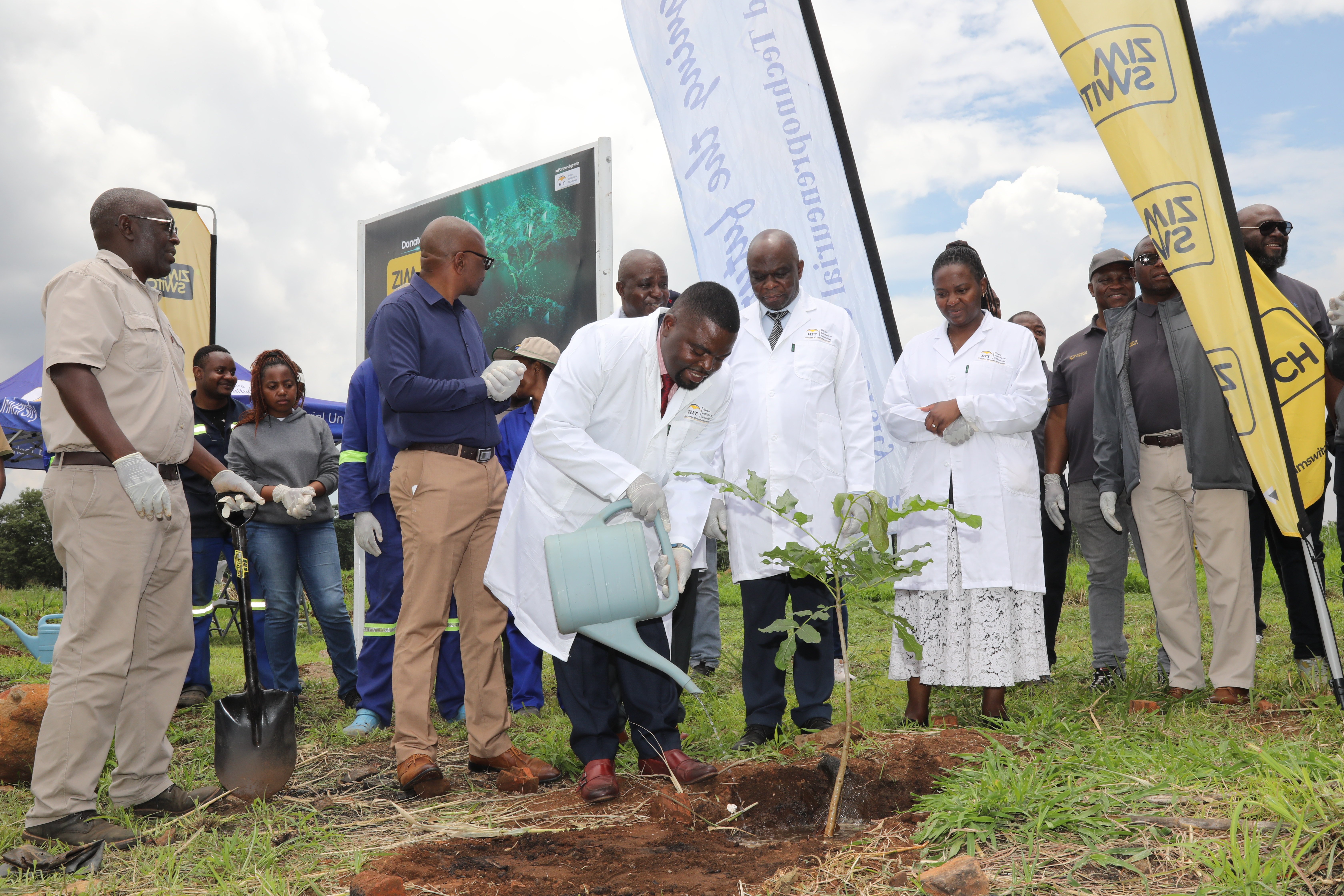
“This isn’t just about putting saplings in the ground.” That was the powerful, unifying message at the heart of Harare Institute of Technology and ZIMSWITCH’s recent Tree Planting Day ceremony. Moving beyond symbolism, the event marked a strategic pivot towards accountable, impactful environmental stewardship that intertwines with education, national development, and technological innovation.
In a gathering that brought together leadership, partners, staff, and students, the message was clear: every tree planted is a promise for the future, and HIT is committed to keeping that promise.
Dr Antony Phiri of HIT’s Environmental Management, Renewable Energy and Climate Change Research Centre (EMRECC) set the tone by challenging the conventional approach. “One-off planting events without survival monitoring become ‘brainwashing,’” he stated plainly. He called for a move towards treating trees as “Environmental Sustainability and Governance (ESG) assets,” valuable instruments that deliver climate resilience, social value, and long-term returns.
His vision is one of rigorous governance, with trees planted and monitored using clear targets, tracked through GIS and Earth Observation tools, and reported through formal frameworks. “This enables auditable data, supports government accountability, and builds investor confidence,” Dr Phiri explained, linking the initiative directly to Zimbabwe’s Climate Change Policy, Vision 2030, and key Sustainable Development Goals. “In short, planting trees is a national development initiative.”
Echoing this commitment to tangible results, HIT’s Vice Chancellor Prof Q.C. Kanhukamwe, in a speech read on his behalf by Pro-Vice Chancellor for Academic Affairs, Mr W. Gwarimbo, welcomed partners and declared sustainability a core, budgeted part of HIT’s vision as an Innovation and Technopreneurial university. “We are shifting from symbolic planting to achieving measurable results,” he affirmed.
Prof Kanhukamwe highlighted the pioneering role of EMRECC in developing a programme to monitor survival rates, growth performance, and carbon sequestration over time. “We are planting trees that will be counted, watched, and reported on, rather than forgotten.” This data-driven approach, he noted, opens doors to sustainability reporting and future carbon finance opportunities, positioning HIT at the nexus of climate innovation and green finance.
The presence and partnership of ZimSwitch significantly bolstered the ceremony. Their Chief Executive Officer, Mr Zabron Chilakalaka, underscored the event as a practical reflection of the company’s ESG commitment. “Environmental stewardship is not merely a corporate obligation, but a pledge to safeguard the natural world for future generations,” he said.
He revealed the deeper purpose of the selected indigenous species: to create a “living laboratory.” These drought-resistant, fast-growing trees will serve as an outdoor lab for student research across disciplines, supporting real-time studies and projects that span academic cycles. “To the students, the trees you plant today will grow alongside your learning journey. Their resilience will mirror your own,” the ZIMSWITCH CEO said.
The Tree Planting ceremony was led by a representative from the Forestry Commission, Mr Duncan Chiwara, who explained the technical benefits of planting and growing trees, as well as how to appropriately plant trees. Together, the messages painted a picture of a holistic, forward-thinking initiative. It’s an effort where environmental action fuels social development, where private-sector leadership aligns with academic rigour and national priorities.
As the shovels turned the earth, the community wasn’t just planting trees. They were planting the seeds for enhanced biodiversity, regulated microclimates, and practical research platforms. They were investing in a model of transparency, partnership, and long-term value.
The trees taking root at HIT stand as a testament to a shared pledge: to build a greener, smarter, and more resilient Zimbabwe, one carefully monitored and nurtured sapling at a time. This is how a university and its partners don’t just celebrate a day, but cultivate a legacy.