
When five students from the Harare Institute of Technology (HIT) boarded their flights to Poland last October, they carried with them laptops, textbooks, and the quiet weight of expectation, both their own and that of an institution committed to shaping Zimbabwe’s rapid industrialisation. What they brought back, four months later, was something far richer: a transformed understanding of their disciplines, a deeper sense of themselves as global citizens, and memories of a country that surprised, challenged, and ultimately embraced them.
Dazylin Manhanga, Yvonne Mhlanga, Percy Magombedze, Precious Charlie, and Nkosiyapha Ncube participated in the prestigious Erasmus+ Student Mobility Programme at Białystok University of Technology (BUT) from 1 October 2025 to 6 February 2026.
Spanning disciplines from Information Technology and Software Engineering to Computer Science and Information Security and Assurance, these five HIT ambassadors immersed themselves in a European academic culture renowned for its rigour, practical focus, and internationalism.
Their stories are individual, vivid, and deeply personal, and together they paint a portrait of what education truly beyond borders means.
Dzień Dobry: Learning to Say Hello
Every great journey begins with a single word. For Yvonne Mhlanga, a Software Engineering student, that word was “Dzień dobry”, the Polish greeting meaning good morning, good day, or how are you doing?, which she and her fellow students stumbled upon in those first bewildering days in a city that felt worlds away from Harare.
“Those first days in Poland were filled with confusion, laughter, translation apps, hand gestures, and patient attempts to learn each other’s languages. Only later did we learn that ‘Dzień dobry’ is a simple greeting. That moment perfectly captures the beginning of our Erasmus journey, unfamiliar at first, but gradually becoming meaningful, welcoming, and transformative,” said Yvonne Mhlanga.
The language barrier was a recurring theme in all five students’ accounts, yet none of them described it as an insurmountable wall. Instead, it became a crucible for adaptability. Dazylin Manhanga, studying Information Technology, noted that navigating everyday communication in a foreign tongue, however frustrating at first, sharpened her problem-solving instincts in ways no formal exercise could replicate.
For Nkosiyapha Ncube, also a Software Engineering student, the challenge of operating independently in an unfamiliar environment translated directly into the kind of self-reliance and professional maturity that the programme was designed to cultivate.
Classrooms with a Difference: The Academic Experience
At BUT, teaching follows a blended learning philosophy that weaves lectures, laboratory sessions, project work, and continuous assessment into a demanding but deeply rewarding whole. For all five students, it was a structure that placed the emphasis firmly on doing rather than merely knowing.
Nkosiyapha completed four courses: Artificial Intelligence, Recommender Systems, Business Application Programming in Java, and Software Development Tools, each worth six ECTS credits and each anchored in practical, task-oriented implementation. He describes the learning environment as one that mirrored real industry expectations far more closely than a purely theoretical curriculum could.
“The learning process placed greater emphasis on individual responsibility and technical output, closely reflecting real industry expectations. Students were required to research solutions, configure development environments, and implement fully functional systems,” noted Nkosiyapha Ncube.
In his Business Application Programming in Java module, Nkosiyapha worked with Jakarta EE, building and configuring enterprise-grade applications with H2 database integration, user authentication and authorisation mechanisms, and object-oriented design principles. His Software Development Tools course took him through professional IDEs including Eclipse, NetBeans, Visual Studio, and VS Code, alongside Git version control workflows and, in a particularly industry-relevant component, both time and memory profiling in Linux and Windows environments using Java and C++.
Yvonne’s Software Engineering coursework covered agile development, requirements engineering, and architectural patterns, with UML artefacts produced collaboratively using Draw.io and Edraw. Her Computer Graphics module explored colour models including RGB, CMYK, and HSV, pixel manipulation, Bézier curves, and image enhancement, all reinforced through Java-based practical projects. In Artificial Intelligence, she moved from theory into hands-on experimentation using AI Space, exploring neural networks, activation functions, and classification techniques.
For Dazylin, the standout experience came in Recommender Systems, where she developed a personalised tourist recommendation platform for Zimbabwean attractions, applying collaborative filtering algorithms including cosine similarity and Pearson correlation in Python.
“I developed a personalised tourist recommendation system for attractions in Zimbabwe. The system allowed users to rate attractions and automatically generated recommendations based on their preferences — demonstrating the practical application of machine learning concepts,” Dazylin Manhanga said.
Nkosiyapha built a similar system independently, constructing a Tourist Recommendation System for Zimbabwe using a dataset of eleven major attractions and a one-to-five user rating matrix. His implementation used Python within a Conda environment, the Surprise library for collaborative filtering, and Streamlit to deliver an interactive web interface capable of predicting unseen ratings and generating dynamic, personalised recommendations in real time.
Percy Magombedze, specialising in AI and Data Science, built two projects that exemplify the programme’s hands-on ethos: a Maze Finder application demonstrating graph traversal algorithms, and his own tourist recommender system. Precious Charlie, studying Information Security and Assurance, found her stride in the Linux Administration module, applying her learning directly to her own Kali Linux environment and gaining practical depth in system configuration, user and group management, and basic scripting.
“Linux Administration was my favourite course because I was able to directly apply what I learned while working with my Kali Linux operating system, strengthening my understanding of system security and automation,” said Precious Rutendo Charlie.
In Database Security, Precious explored how Oracle views support data confidentiality, and how users, roles, and privileges enforce authentication and controlled access — principles central to her future career. Dazylin’s Computer Networks laboratory sessions had her configuring VLANs, DHCP services, OSPF dynamic routing, NAT, and firewall rules on MikroTik routers and Linux systems, competencies directly transferable to enterprise environments in Zimbabwe.
A Different Way of Learning
One theme that runs through all five accounts is the quality and character of the teaching at Białystok University of Technology. Courses were structured around independent learning, problem-solving, and technical output rather than rote examination. Students were expected to configure their own development environments, research their own solutions, and deliver functional, working systems.
For Nkosiyapha, this was one of the programme’s most meaningful dimensions. The rigour of the academic workload, combined with the expectation of individual responsibility, produced a kind of intellectual confidence that he describes as central to his growth during the four months. Percy echoed this, noting that the education he received was simply high quality, useful in ways that extended well beyond the examination room.
Yvonne found that the structure of continuous assessment, group projects, and presentations developed not only her technical documentation skills but also her confidence in communicating complex ideas to mixed audiences, an essential skill in any professional technology environment. Precious noted that the guided exercises in her Artificial Intelligence module, tracing how intelligent systems are trained over multiple epochs and evaluated, improved her analytical and problem-solving skills more than any lecture-only format could have achieved.
Beyond the Lecture Hall: Poland as a Living Classroom
Poland proved to be a remarkably generous classroom in its own right. The five students arrived in a country with a proudly maintained language, a sophisticated public infrastructure, and a technology ecosystem that left them continuously impressed.
Percy was struck by the seamlessness of everyday technology: self-service grocery tills that unlock exit doors via QR-code receipt scanning, hotel elevators that move only to a guest’s authorised floor upon card tap, and a public transport network so efficient that traffic jams are a rarity. Cashless and contactless payments via NFC were ubiquitous, a technology Dazylin also encountered through Poland’s BLIK mobile payment system, enabling secure real-time transactions through standard banking apps.
“The technology and innovations I was exposed to were top-notch. Payments were made mostly via NFC technology, whereby a person just taps their phone on the POS and the transaction is completed instantly,” Percy Magombedze noted.
Yvonne drew lessons from Poland’s cultural values as much as from its technology. The principles of punctuality, structure, and efficiency, visible in academic schedules, public systems, and banking infrastructure, reshaped her approach to time management and professional responsibility. These are not merely European habits; they are professional disciplines that she intends to carry forward throughout her career.
For Nkosiyapha, the independence demanded by the programme, navigating a new city, managing a demanding academic workload, and operating entirely in a second language, was itself a form of professional preparation. The mobility period had replaced his industrial attachment component at HIT, and he found that it delivered everything that attachment was designed to provide, and more: exposure to real-world computing tools, industry-relevant methodologies, and the self-sufficiency required of a practising software engineer.
Precious participated in university-organised trips and Erasmus social activities, finding in the student residence a vibrant, multicultural community that enriched her perspective on international collaboration. For all five, the social fabric of Białystok, its friendly people, its community spirit, and its openness to visitors, made the city feel, in time, like a second home.
Sadza in Poland: Representing Zimbabwe on the World Stage
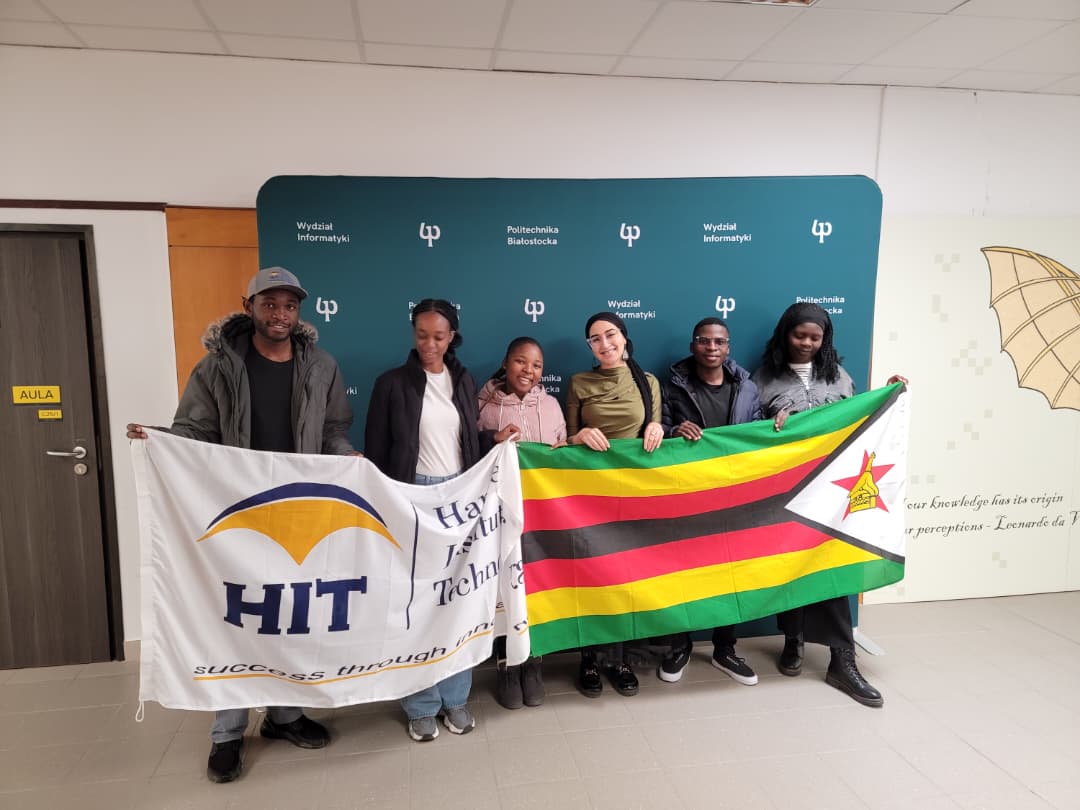
Perhaps the most vivid and heart-warming chapter in the collective story of these five students is the moment they became ambassadors not merely of HIT, but of Zimbabwe itself. During a cultural exchange event at BUT, the group participated in an international cooking competition that drew teams from across the globe.
Wrapped in the Zimbabwean flag and armed with ingredients for sadza and gango, the full HIT contingent, Yvonne, Precious, Dazylin, Nkosiyapha, and Percy, prepared their traditional dishes for an audience of students from ten different countries. They finished fifth overall, a result that belies the warmth of the reception their food received.
“Watching people from different cultures enjoy our traditional food, smiling as they tried to pronounce its name, was a truly memorable and heart-warming experience,” said Yvonne Mhlanga.
The moment is small in the grand arc of the programme, but it is deeply significant. Five young Zimbabweans, far from home, chose to celebrate their heritage, and in doing so, gave everyone around them a taste of their country’s warmth, culture, and identity.
Krakow, Cloud Computing, and the Industry-Academia Bridge
One of the most consequential experiences of Percy’s mobility period came when he travelled from Bialystok to Krakow to participate in a Cloud Computing EuroClear Hackathon. The event exposed him to enterprise-grade cloud platforms deployed in real industrial contexts, but it was the broader culture of innovation surrounding the hackathon that made the deepest impression.
“Almost every week, companies host workshops, competitions and networking events for both students and industry professionals. This culture of bridging academia and industry is something the Harare Institute of Technology can benefit greatly from, and in many ways is already well positioned to lead.” Percy said.
Percy returned from Krakow with a concrete vision: semester-based hackathons at HIT themed around Zimbabwe’s priority sectors, agriculture, mining, energy, and fintech, judged by industry partners; companies sponsoring final-year capstone projects; smart NFC payment systems on campus; and card-based access control for laboratories and server rooms, modelled on the systems he encountered in Polish hotels.
Nkosiyapha’s own exposure to professional software development tools and enterprise Java frameworks at BUT points in the same direction: a call for HIT to deepen its alignment with international industry standards, embedding tools like Git, performance profiling, and enterprise application frameworks into its Software Engineering curriculum as standard practice rather than electives.
It is the kind of thinking that Erasmus+ is designed to catalyse: students who do not merely absorb international experience but actively translate it into proposals to develop their home institutions and communities.
Coming Home: What They Carried Back
When asked to summarise what the experience gave them, each student’s answer reaches well beyond the academic transcript. For Dazylin, it was the deepening of technical knowledge alongside a newfound appreciation for adaptability and cross-cultural communication. For Yvonne, a global perspective and professional discipline were shaped by Polish values of punctuality and structure. For Precious, resilience, confidence, and a sharpened identity as a practitioner in information security. For Percy, an international understanding of how technology universities can drive national development.
And for Nkosiyapha, it was the wholeness of the experience, the sense that four months in Poland had delivered not just new technical competencies in AI, enterprise Java, recommender systems, and software tooling, but a more complete version of himself as a software engineering professional: independent, analytically rigorous, and ready for the demands of real-world practice.
“The knowledge and competencies gained during this period directly support my Bachelor of Science in Software Engineering at HIT and contribute positively to my preparation for a professional career in the software engineering field,” Nkosiyapha added.
Yvonne’s closing reflection speaks for all five:
“This Erasmus experience transformed me academically, professionally, socially, and personally. I gained advanced technical skills, cultural awareness, independence, and a global perspective. This chapter has prepared me for future challenges and reaffirmed my belief in the power of education beyond borders,” Yvonne reflected.
The five students are unanimous in their gratitude to HIT for facilitating this opportunity, and to Bialystok University of Technology for welcoming them so generously. They are equally united in their belief that international mobility is not a luxury, but a formative investment in the kind of technology professionals that Zimbabwe needs and deserves.
Bialystok is many thousands of kilometres from Harare. In every way that matters, however, these five students have made that distance smaller, for themselves, for HIT, and for every future student who will one day stand in Poland, clutching a translation app, and slowly, joyfully, learning to say Dzień dobry.