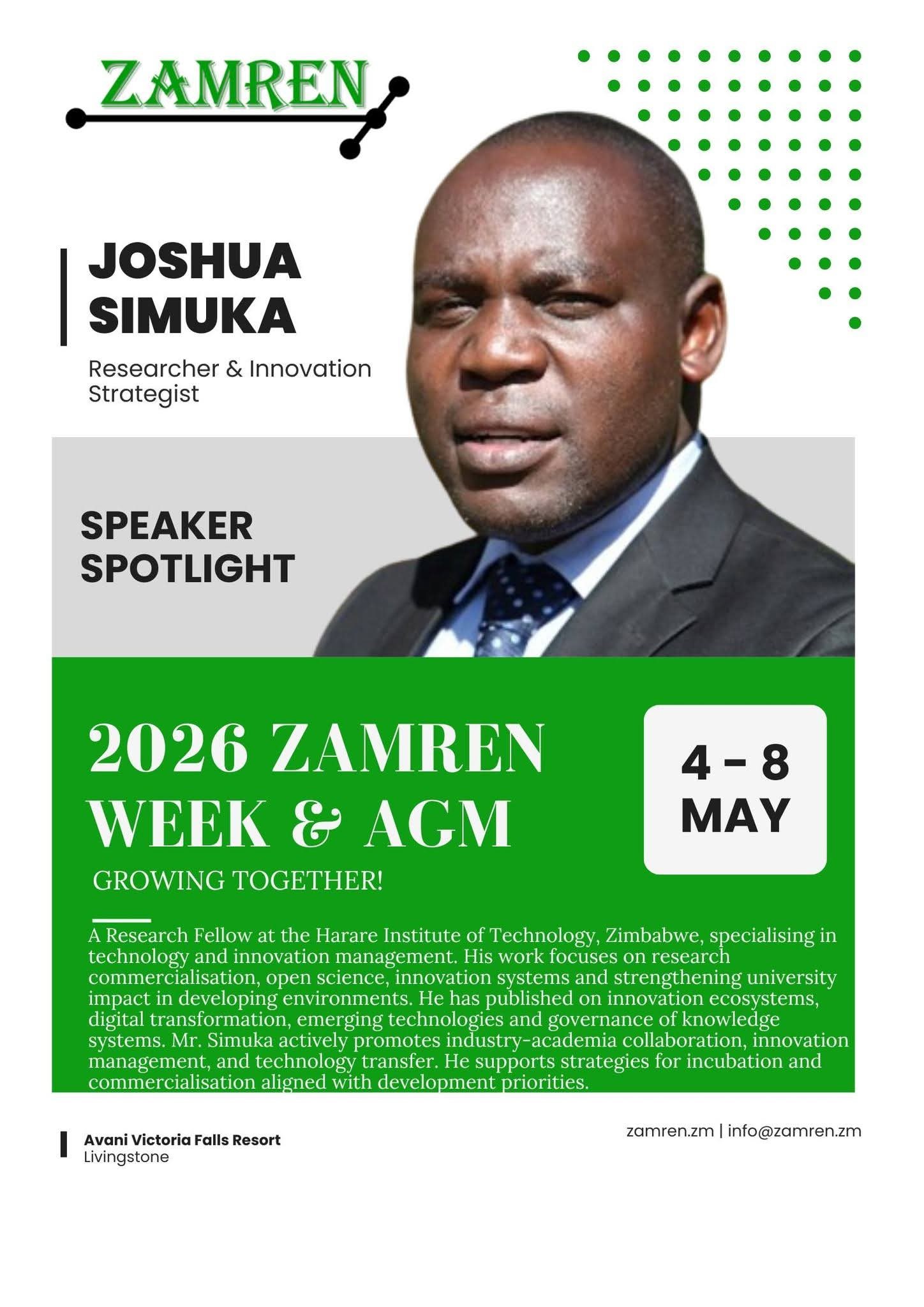


When Joshua Simuka stepped onto the podium at ZAMREN Week 2026 in Zambia, he carried with him more than a research paper. He carried a challenge, one directed at universities across Africa to fundamentally rethink the role of Open Access in driving economic transformation.
Simuka, a Research Fellow in the Postgraduate Unit of Strategy and Innovation at Harare Institute of Technology (HIT), presented a strategic paper titled ‘Open Access as a Driver of Knowledge Commercialisation and Societal Impact’ at the high-level regional conference held from 4 to 8 May 2026, under the theme ‘Growing Together.’
A Conference at the Cutting Edge
ZAMREN Week 2026 brought together Vice Chancellors, policymakers, researchers, librarians, innovation leaders, National Research and Education Networks (NRENs), ICT specialists, and industry stakeholders from across the African continent. The agenda was ambitious — deliberating on the future of higher education, open science, cybersecurity, digital transformation, research visibility, and commercialisation.
It was precisely the kind of platform where bold ideas are tested, and Simuka’s paper did not disappoint.
Repositioning Open Access
At the heart of the presentation was a compelling repositioning of Open Access — moving it far beyond its traditional framing as a publishing tool. Rather than viewing Open Access merely as a mechanism for making academic papers freely available, the paper argued for its recognition as a strategic driver of innovation diffusion, industrial engagement, entrepreneurship, commercialisation, and societal transformation.
The paper demonstrated that when research outputs remain locked behind paywalls, the consequences are far-reaching: reduced opportunities for the uptake of innovation, limited industrial application, constrained startup development, and diminished societal utilisation of university-generated knowledge.
Perhaps most provocatively, the paper challenged the widely-held belief that Open Access weakens intellectual property protection and undermines commercialisation. Instead, Simuka argued that Open Access and commercialisation are not in tension; they can and should work together, provided institutions build robust systems for IP management, technology transfer, embargo management, and commercialisation readiness.
The Case for Institutional Transformation
The paper drew considerable interest from regional universities and innovation stakeholders, resonating particularly with those grappling with questions of research relevance and impact. Its findings pointed clearly to the need for institutional transformation, away from traditional knowledge generators and toward active, impact-driven innovation ecosystems.
“The future of universities lies not only in generating knowledge, but in transforming that knowledge into industrial solutions, start-ups, policy influence, technopreneurial opportunities, and measurable societal impact. Research that remains inaccessible cannot fully transform economies or societies. Open Access, when strategically aligned with intellectual property protection and commercialisation systems, becomes a powerful driver of innovation diffusion, industrialisation, collaborative development, and national transformation. Universities must therefore position themselves as active innovation ecosystems capable of converting research into technologies, enterprises, and impactful solutions that improve lives and accelerate development,” said Joshua Simuka,
Aligned with HIT’s Mandate
The participation is a natural extension of HIT’s core institutional mandate — developing, incubating, transferring, and commercialising technology for the rapid industrialisation of Zimbabwe and beyond. Simuka’s paper made explicit the links between open knowledge systems and the kind of technology-driven economic development that HIT champions through its technopreneurial and innovation programmes.
Beyond the formal presentation, ZAMREN Week 2026 offered important opportunities for strategic networking, collaborative research partnerships, and institutional benchmarking against emerging global best practices in Open Science, commercialisation, and innovation management — all areas where HIT continues to develop its institutional capabilities.
Building Regional Visibility
HIT’s participation at ZAMREN Week 2026 adds to a growing portfolio of high-level regional and international engagements that are cementing the institution’s reputation as a leading innovation-driven and technopreneurial university in the region. As universities across the world increasingly prioritise research visibility, societal impact, entrepreneurship, and commercialisation, HIT is steadily building an integrated innovation ecosystem positioned to contribute meaningfully toward industrialisation, technological advancement, and sustainable national development.
The message from Zambia is clear: the walls that once separated knowledge from application, research from industry, and academia from society are coming down, and HIT is helping to tear them down.